
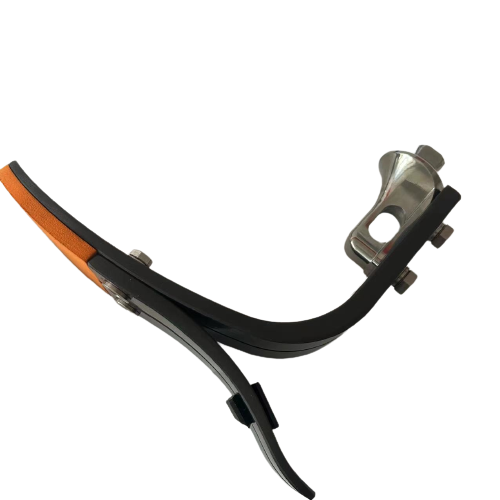
A carbon fiber prosthetic foot looks like a curved blade — simple, almost architectural. The engineering inside it is anything but simple. That curved carbon fiber element, usually 3-8mm thick and weighing under 300 grams, has to store the kinetic energy of a human stride, release most of it back into the next step, and do this roughly two million times before showing fatigue cracks. The best ones return 85-95% of the loading energy. A human Achilles tendon returns about 35%.
The prosthetic foot market has shifted almost entirely to carbon fiber over the past 15 years. Titanium and aluminum feet still exist, mostly in developing markets where cost trumps performance, but carbon fiber’s combination of high specific stiffness, fatigue life, and energy return makes it the engineering material of choice. The question for manufacturers isn’t whether to use carbon fiber — it’s which fiber, which layup, which resin, and which process.
What Is a Carbon Fiber Prosthetic Foot — Material Science & Engineering Principles
A prosthetic foot is a mechanical spring. The user loads it during the stance phase of gait — body weight plus momentum compresses and flexes the foot structure. During push-off, the stored elastic energy is released, propelling the user forward. The difference between a $200 carbon foot and a $2,000 one is mostly in the efficiency of that energy storage and return cycle.
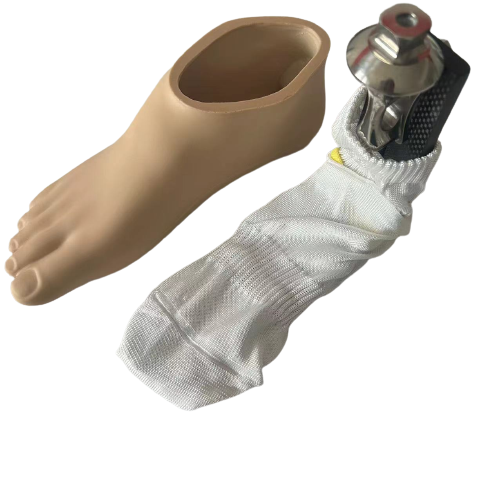
The foot structure typically consists of a primary load-bearing element (the “keel” or “blade”), a heel element for shock absorption at initial contact, and a cosmetic foot shell. The keel is where carbon fiber does the heavy lifting. It’s a laminated composite structure, usually produced by prepreg compression molding — layers of pre-impregnated carbon fiber fabric (typically 2×2 twill weave or unidirectional tape) stacked in a specific orientation sequence, then cured under heat and pressure in a matched metal mold.
The fiber orientation determines everything about how the foot behaves. Unidirectional carbon fiber running along the long axis of the keel gives high flexural stiffness and energy return — the fiber acts like a leaf spring, storing elastic energy in tension along the bottom surface and compression along the top. Off-axis plies at ±45° control torsional stiffness — how much the foot twists during uneven ground walking. A foot with too much torsional stiffness feels like walking on a rigid blade. Too little and the user can’t trust it on stairs or slopes.
“The first time I walked on a carbon foot after two years in a basic SACH foot, I kept overshooting my step. The energy return was that much higher — I had to re-learn where my foot was going to end up at the end of each stride.” — Below-knee amputee, 3 years post-fitting
Performance Data & Mechanical Properties
The numbers that matter for a prosthetic foot aren’t the ones that matter for an aerospace bracket. Fatigue life and energy return dominate. Here’s how carbon fiber prepreg systems compare to the legacy materials.
| Property | Carbon Fiber Prepreg (T300/Epoxy) | Carbon Fiber Prepreg (T700/Epoxy) | Titanium (Ti-6Al-4V) | Nylon 6/6 (GF reinforced) |
|---|---|---|---|---|
| Tensile modulus (GPa) | 130-135 | 230-240 | 110 | 8-10 |
| Specific stiffness (GPa/g·cm³) | 83 | 135 | 25 | 7 |
| Energy return (%) | 85-93 | 90-95 | 60-70 | 50-65 |
| Fatigue life (cycles to failure) | 2-3 million | 2-3 million | 5+ million | 0.5-1 million |
| Density (g/cm³) | 1.55 | 1.55 | 4.43 | 1.35 |
| Component weight (typical, grams) | 250-400 | 220-350 | 450-700 | 300-500 |
| ISO 13485 medical compliance | Yes | Yes | Yes | Partial |
The energy return numbers explain why carbon dominates. A titanium foot gives back 60-70% of the energy put into it. A well-designed T700 carbon foot gives back over 90%. For an amputee walking 5,000 steps a day, that difference adds up to roughly 15-20% less metabolic energy expended — the equivalent of carrying a 5-kg backpack versus not carrying one.
T700 fiber’s higher modulus (240 GPa vs 130 GPa for T300) lets designers use thinner laminates for the same stiffness, which reduces weight. But higher modulus also means lower strain to failure — T700 breaks at about 1.8% elongation, T300 at 1.5%. Neither stretches much, which is why carbon feet feel stiff compared to anatomical feet. The art is tuning the layup to provide enough compliance at initial ground contact while still returning energy efficiently.

Manufacturing Process & Quality Control
Carbon fiber prosthetic feet are almost exclusively made by prepreg compression molding. Here’s the production flow:
Prepreg cutting and kitting. Rolls of carbon fiber prepreg — typically 120-250 gsm fabric weight with 35-42% resin content — are cut into specific ply shapes using CNC ply cutters or steel rule dies. A typical foot keel uses 8-20 plies depending on the user’s weight category (active-duty ratings run 45-166 kg). Each ply is cut to a slightly different shape to create the tapered thickness profile that gives the foot its progressive stiffness curve.
Layup. Plies are stacked in a specific sequence and orientation. A common layup for a general-purpose foot keel: [0°/±45°/0°/0°/±45°/0°]s (12 plies, symmetric about the midplane). The 0° plies (fiber along the long axis) carry bending loads. The ±45° plies provide torsional stiffness and prevent longitudinal splitting. Symmetric layup prevents warping during cure — a non-symmetric layup will curl like a potato chip when it comes out of the mold.
Compression molding. The layup goes into a matched metal mold preheated to 130-150°C. The press closes at 3-7 bar, and the prepreg cures under heat and pressure for 15-45 minutes depending on the resin system. The mold cavity defines the final shape of the foot keel — the curve geometry, the heel-to-toe drop, the split-toe configuration (many sport feet have a longitudinal split down the middle to allow independent medial/lateral flex).
Post-cure and finishing. Some epoxy systems get a free-standing post-cure at 80-100°C for 2-4 hours to maximize glass transition temperature and mechanical properties. After cure, the keel is trimmed with a diamond wheel or waterjet, bolt holes are drilled for the pyramid adapter connection, and the surface gets a light sanding or clear-coat for aesthetics.
Quality control. Every foot keel should be tested before it ships. Static load testing at body-weight-rated loads (ISO 10328 covers prosthetic testing standards) checks deflection under load. Ultrasonic C-scan inspection catches internal delaminations, voids, or dry-spot defects that would grow into fatigue cracks. The best manufacturers test one foot per batch to 2 million cycles on a servo-hydraulic fatigue tester to validate the process, plus static test every production foot.
Application Spectrum: Where Carbon Fiber Feet Excel
Not every amputee needs a carbon fiber foot. A low-activity elderly user who walks on flat ground at slow speed will be fine with a basic polypropylene foot. Carbon pulls ahead for three user profiles.
K3-K4 activity level users. These are amputees who walk at variable cadence, navigate stairs and uneven terrain, and may run or play sports. A carbon fiber foot stores energy during the loading response and returns it at terminal stance — exactly when the user needs propulsion. The effect is most noticeable above 3 km/h walking speed. Below that, elastic energy storage and return becomes negligible compared to the viscoelastic losses in the residual limb socket interface.
Sports-specific applications. Running blades are the most visible example — the curved J-shaped carbon fiber sprinting feet seen in Paralympic competition. These are optimized for maximum energy return at running cadence (180-220 steps/minute) and sacrifice walking comfort for sprinting efficiency. A running blade stores energy like a bow: the curve geometry, ply orientation, and laminate thickness are tuned to match the user’s body weight and running speed. Too stiff and the blade doesn’t compress enough to store meaningful energy. Too soft and it bottoms out.
Uneven-terrain and outdoor use. Feet with split-toe carbon fiber keels let the medial and lateral halves flex independently, providing ankle-like inversion/eversion motion on uneven ground. A hiker stepping on a rock with the inside edge of the foot gets that half of the keel to deflect without tipping the entire foot. Split-toe designs with carbon fiber are 3-4× more torsionally compliant than solid-blade designs while maintaining the same sagittal-plane stiffness.
Limitations & When NOT to Use Carbon Fiber Feet
Carbon fiber feet have failure modes worth knowing about before you specify one.
Not for water immersion without protection. The carbon/epoxy composite itself doesn’t absorb significant water, but the fiber-matrix interface degrades with prolonged water exposure. A foot used for swimming or beach walking should have a sealed cosmetic cover and the user should rinse it with fresh water afterward. Feet that go through hundreds of wet-dry cycles without protection will start delaminating within 2-3 years around the bolt holes.
Not immune to impact damage. A carbon foot that can handle 2 million walking cycles can be destroyed by one hard impact on the edge. Dropping a 20kg weight on the side of the keel can create an internal delamination invisible from the outside. Six months later, the foot snaps during normal walking. If a carbon foot takes a sharp impact, get it inspected (ultrasonic or tap-test) or replace it.
Stiffness is not adjustable after manufacture. A titanium foot can be shimmed, adjusted, or swapped to a different spring rate. A carbon foot’s stiffness is baked into the layup and cure cycle. If the foot feels too stiff or too soft for the user, the only fix is a different foot category. This is why good prosthetic clinics maintain a loaner inventory — you try before you buy.
Cost barrier for low-resource settings. A quality carbon fiber prosthetic foot costs $800-3,000. In markets where per-capita healthcare spending is under $100/year, that’s a non-starter. Lower-cost hybrid designs (carbon fiber forefoot bonded to a glass-fiber heel) are emerging at $200-400, but they compromise on energy return (70-80% vs 90%+ for all-carbon).
Latest Industry Innovations & Research
The carbon fiber prosthetic foot market has been a mature product category for about a decade, but three developments are active areas of R&D:
Variable-stiffness laminates using spread-tow fabrics. Standard prepreg plies have uniform fiber areal weight across the sheet. Spread-tow technology spreads each carbon tow into a thin, flat ribbon (20-50mm wide, 0.02-0.05mm thick), which allows designers to vary the local fiber volume within a single ply — denser fiber in the high-stress midfoot, less fiber toward the toe for a softer toe-off. This reduces the total ply count and eliminates the stepped thickness transitions that are stress concentrators in conventional layups.
Thermoplastic matrix systems (PEEK, PEKK). Almost all current carbon feet use epoxy prepreg. Epoxy has excellent mechanical properties but limited toughness — impacts that debond the fiber-matrix interface are permanent. Thermoplastic carbon fiber composites (carbon/PEEK, carbon/PEKK) have 3-5× higher mode I interlaminar fracture toughness and can be thermoformed after lamination for local shape adjustments. The processing is more demanding (350-400°C molding temperature, rapid heat-up/cool-down cycles), and the material cost is 5-10× higher than epoxy prepreg. Current application: military-grade prosthetic feet where impact tolerance is non-negotiable.
Recycled carbon fiber in intermediate plies. A few European manufacturers are substituting 10-20% of the core plies with nonwoven mats made from recycled aerospace carbon fiber. The mechanical performance of recycled mats is lower than virgin fabric (random fiber orientation instead of aligned), but in the neutral-axis region of the keel (where bending stress approaches zero), performance doesn’t matter. Using recycled fiber in the core plies cuts material cost 10-15% and scores sustainability points without compromising function.
How long does a carbon fiber prosthetic foot actually last?
3-5 years for an active daily user (K3 level, 5,000-8,000 steps/day). The manufacturer warranty usually says 2-3 years, but real-world data from prosthetic clinics shows most feet go 4-5 years before retirement. Failure mode is rarely catastrophic breakage — more often it’s gradual softening as micro-delaminations accumulate, reducing energy return to where the user notices it feels “dead” compared to a new foot.
Can a carbon fiber foot be repaired if it delaminates?
Not reliably. Unlike metal parts that can be welded, a delaminated carbon fiber composite can’t be re-bonded with any guarantee of fatigue life. The delamination surface is contaminated with cured resin and moisture. Even if you inject new epoxy and re-cure, the repair has roughly 30-50% of the original interlaminar strength. For a device that your mobility depends on, replacement is the safe call.
What’s the difference between a T300 and T700 carbon foot in practice?
T700 is stiffer per unit thickness, so a T700 foot can be thinner and lighter for the same stiffness rating. For a 75kg user, a T700 keel typically weighs 240-280g vs 300-350g for T300. The difference of 50-70g sounds small, but the foot is at the end of a lever arm — every gram saved at the distal end of the prosthesis reduces the pendulum effect during swing phase. Users consistently rate lighter feet as more comfortable for all-day wear.
Do carbon fiber feet work in cold weather?
Yes. The epoxy matrix gets slightly stiffer below -20°C, which can make the foot feel about 5-10% stiffer than at room temperature. But carbon fiber itself has essentially zero thermal expansion, and the composite doesn’t embrittle at cold temperatures the way some thermoplastics do. Feet have been used in Nordic skiing and winter sports without cold-weather-specific failures.
